
You Should Update Your Resume—Even If You’re Not Job Hunting
Think of your resume as professional spring cleaning. You don’t wait until your house is a mess to clean it—and you shouldn’t wait until you’re looking for a job to update your resume.
Think of Updating Your Resume as Professional Spring Cleaning
Your resume is living record of your professional journey. It shouldn’t be ignored until you’re unemployed or ready to leave your current position.
Just as regular spring cleaning keeps your home organized and prevents small tasks from becoming overwhelming, regular resume maintenance keeps your career story current and prevents a future job search from becoming a major reconstruction project.
Once a year, take an hour. Look at what you’ve accomplished. Add what has changed. Remove what no longer matters. Capture the successes you might otherwise forget.
You may not be job hunting today, but keeping your resume current means you’ll be ready if tomorrow brings an opportunity worth pursuing.
Many professionals make the mistake of only looking at their resumes when they’re ready (or forced) to make a career move. By then, months—or even years—of accomplishments, new responsibilities, skills, and recognition may be difficult to reconstruct.
Regular resume maintenance solves that problem.
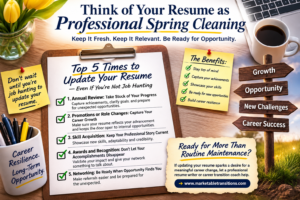
Here are four times when you should consider giving your resume a refresh—even if you’re perfectly happy in your current role.
- Annual Review:
A new year is a natural time to reflect on the previous year’s accomplishments. Your annual performance review is another.
Use that opportunity to ask yourself:
What did I accomplish this year that I want a future employer or professional contact to know about?
Document your achievements
Projects completed, problems solved, costs reduced, teams developed, new responsibilities assumed, and recognition received can quickly become yesterday’s news. Capture those accomplishments while they’re still fresh.
Don’t simply record what you were responsible for. Record what you accomplished.
Prepare for the unexpected
Career opportunities rarely arrive on a predictable schedule. An interesting project, an internal opening, a recruiter’s call, or an introduction through your professional network can happen at any time.
An updated resume means you don’t have to scramble to reconstruct your career history when an opportunity appears.
- Career Growth
A promotion or significant change in responsibilities is one of the clearest signals that your career is evolving. Don’t wait until you’re ready to leave your company to document that progression.
Highlight advancement
Your career progression tells a story. Make sure your resume tells the complete story—not just the final chapter. If your role expanded from managing a function to leading an organization, or from supporting one business unit to working across multiple businesses, make sure your resume reflects that growth.
Keep the door open to internal opportunities
You may not be looking outside your organization, but opportunities within your company can appear just as unexpectedly. An updated resume makes it easier to demonstrate your qualifications when the next opportunity arises.
- Certificates & Awards
Keep Your Professional Story Current
Learning doesn’t stop when you finish school. New technology, processes, certifications, systems, and responsibilities continually change what employers expect from professionals.
Whenever you acquire a meaningful new skill, consider whether it belongs on your resume.
Demonstrate adaptability and build professional credibility
Certifications, specialized training, new systems expertise, leadership development, and other professional development can strengthen your professional profile.
But don’t simply create a long list of courses. Focus on the skills and knowledge that expanded your responsibilities and contributions.
Awards and Recognition:
Don’t let your accomplishments disappear, give your network something to talk about
Recognition provides evidence that your contributions mattered. Adding awards and accomplishments to your resume helps preserve that evidence.
Your accomplishments are also useful conversation starters. When you’re networking with colleagues, recruiters, industry contacts, or potential mentors, specific accomplishments provide a much stronger basis for conversation.
- Networking
One of the biggest mistakes professionals make is assuming that a resume is only useful when they’re actively applying for jobs.
Networking can create opportunities long before a formal job search begins.
A colleague may introduce you to an executive. A former coworker may hear about an opening. A recruiter may contact you about a position you haven’t considered. An industry connection may suggest a consulting project or leadership opportunity.
Make referrals easier
When someone asks, “Can you send me your resume?” you don’t want to spend the next several days trying to remember everything you’ve accomplished over the past five years.
An updated resume allows you to respond quickly and professionally.
Be prepared for the unexpected
You don’t have to be looking for a job to be interested in an opportunity, sometimes the best career moves are the ones you didn’t plan.
What If Updating Your Resume Makes You Want to Make a Change?
From time to time, professional spring cleaning uncovers more than an outdated resume. It can make you realize that you’re ready for something different.
Have you outgrown your current role? Has your industry has changed?
Maybe you’re ready for greater responsibility, a new direction, or a career that better reflects the skills you’ve developed.
If updating your resume starts you thinking, “Maybe it’s time for a change,” don’t stop with only updating the document.
If you’re ready to move from routine resume maintenance to a meaningful career transition, explore how professional resume writing and career transition coaching can help at www.marketabletransitions.com.